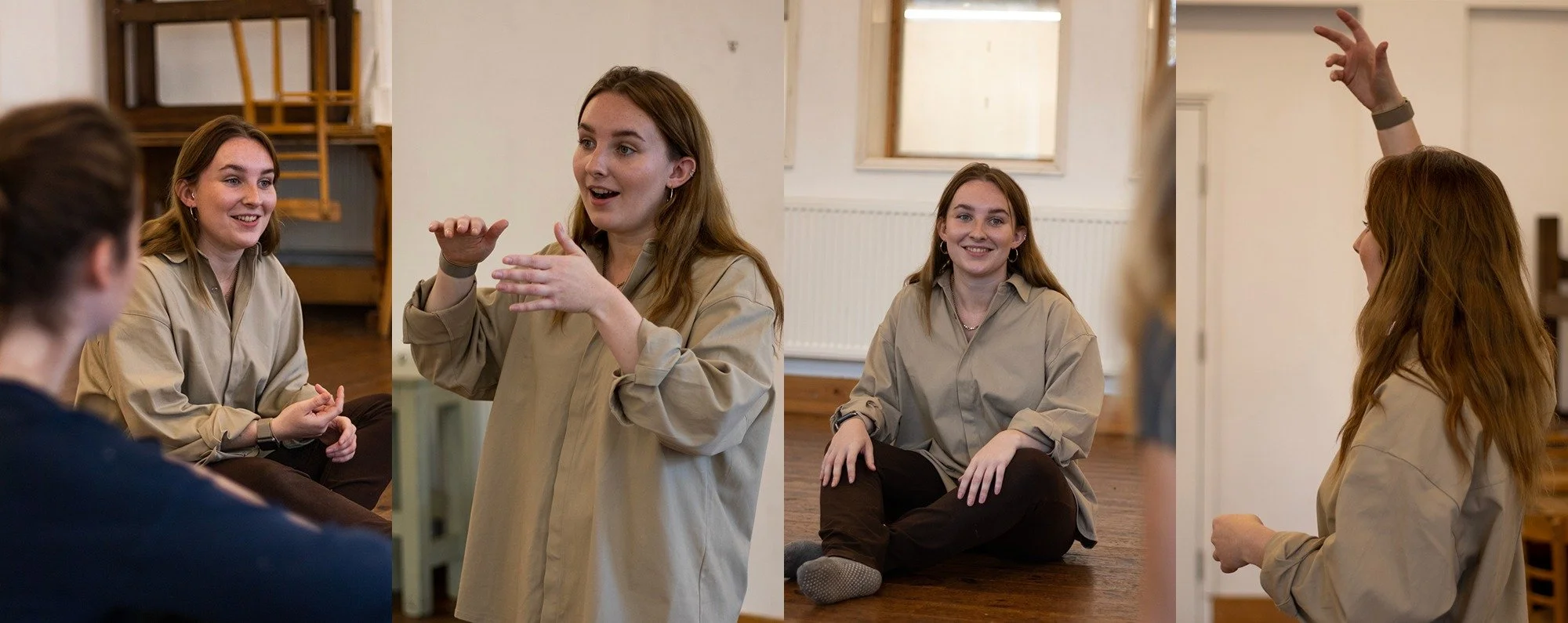
Why Making Strange Noises in a Boardroom Works by Molly Parker
Actors and CEOs have a lot more in common than you’d think, according to voice and accent coach Molly Parker. Whether it’s performing in front of a sold-out audience, recording a voiceover ad, or pitching to a board of executives, they’re all engaging in voice work and asking their audience to pay attention. Molly shares how, through her work, she’s seen the transformative impact that bringing actors’ voice techniques into corporate environments can have on communication.

by Molly Parker
(https://www.mollyparkervoice.com/)
A few years ago, if someone had told me I would be running articulation exercises with a room full of consultants and finance executives, I probably would have laughed. My training came through theatre, where warming up your voice is the norm. Actors roll their shoulders, stretch their faces into strange shapes, breathe together, make odd sounds, and generally look a bit ridiculous before speaking a line of text. The body is part of the process. Corporate spaces, understandably, are not usually set up for that.
People tend to walk into meeting rooms with laptops, coffee, and the quiet agreement that communication is mostly about information. Slides are ready. The structure is clear. Efficiency is the aim. If the material is strong enough, the message should land. That is usually the assumption.
And yet, over the last few years, I have found myself increasingly invited into those rooms to work on something different. Not what people say, but how they say it. The energy behind a sentence. The breath underneath it. The rhythm, the hesitation, the small shifts in confidence that happen while someone is speaking.
I sometimes think this interest has sharpened slightly in the age of AI. The more polished and automated our written communication becomes, the more noticeable the human voice suddenly is. When someone speaks, you hear personality again. Thought happening in real time. Slight imperfections that make it clear a real-life person is there.
The strange thing is that most people have never really explored their voice in any deliberate way. Actors spend years doing this. It is built into the training. Most professionals, however, spend their entire careers speaking in important rooms without ever being given the space to play with how their voice actually works.
One of the first things I ask people to do in a workshop is very simple. I ask them to stand up and describe what they do in ten words.
Now, standing alone may feel simple to you, but I’ve been in rooms where this instruction alone causes people to break into a sweat. Ten words sounds straightforward, but it becomes surprisingly complicated. People begin staring at the ceiling, counting on their fingers, quietly renegotiating with themselves about whether eleven words might be acceptable if nobody is keeping a strict score.
It is meant to be a small ice breaker, but people suddenly start thinking about speaking with intention. What matters in those ten words. Where the sentence lands. Which word carries the weight. Without realising it, they are doing something actors spend years practising, which is deciding what they want a line to do.
The more time I spend in these rooms, the more it becomes clear to me that people do not need fixing when it comes to their voice. There is nothing “wrong” with them. What tends to happen instead is that people get stuck in a certain stiffness. They start speaking in order to prove something rather than to move someone.
I want to prove to my boss I did the work. I want to show my audience I am the expert.
These motivations make complete sense, but they rarely produce the most interesting communication. Actors learn very quickly that proving something is not a particularly playable action. It tends to shut the voice down rather than open it up.
When the intention shifts, the voice shifts with it. Instead of proving competence, someone might try to motivate their team, convince a colleague, or help a room care about an idea. As soon as the focus moves away from themselves and onto the person listening, the voice becomes more alive.
At that point, the room starts to ease and the work becomes more playful. We might experiment with saying the same sentence with different intentions. Encouraging someone. Challenging them. Persuading them. Sometimes we borrow ideas from Laban movement work and play with different physical energies. People notice quite quickly that when the body changes, the voice changes with it.
Eventually we move into articulation exercises, which is where the room often tips into mild chaos. Big exaggerated mouth movements. Tongue twisters delivered with far more enthusiasm than anyone expected five minutes earlier. Consonants being over pronounced to a ridiculous degree.
At first everyone is very aware that their colleagues are watching them. The room can feel a bit stiff. But then, someone laughs. Shoulders drop. Breathing deepens. The atmosphere softens.
And that is usually the moment when the voice appears.
One of the things this work has taught me is that voice is not just an individual skill. Of course you can work with someone’s breath or articulation or pacing. But voice is also shaped by the environment people are speaking in. A tense room produces tense voices. A relaxed room produces open ones.
So a lot of the work is really about shifting the atmosphere of the room. When one person relaxes slightly it changes something. When several people do, the dynamic moves quite noticeably. The voices that emerge in that environment sound more confident, but also more natural. Not performative. Just human.
What fascinates me about bringing play into corporate spaces is how quickly it unlocks something. Adults spend most of their professional lives trying to sound correct, professional, and controlled. Play interrupts that pattern.
Actors train their voices so they can move between characters, emotions, and environments. Corporate professionals are not performing theatre, but they are still moving between rooms, audiences, and stakes. Each situation asks for a slightly different energy.
Voice work simply gives people permission to explore that range.
The surprising discovery for most people is that they do not need a completely new voice. The voice they already have is persuading, explaining, connecting, and leading every day.
Most of us simply never realised it was an instrument we could learn to play. I get to spend my days watching people realise that, which feels like a pretty good job to have.